

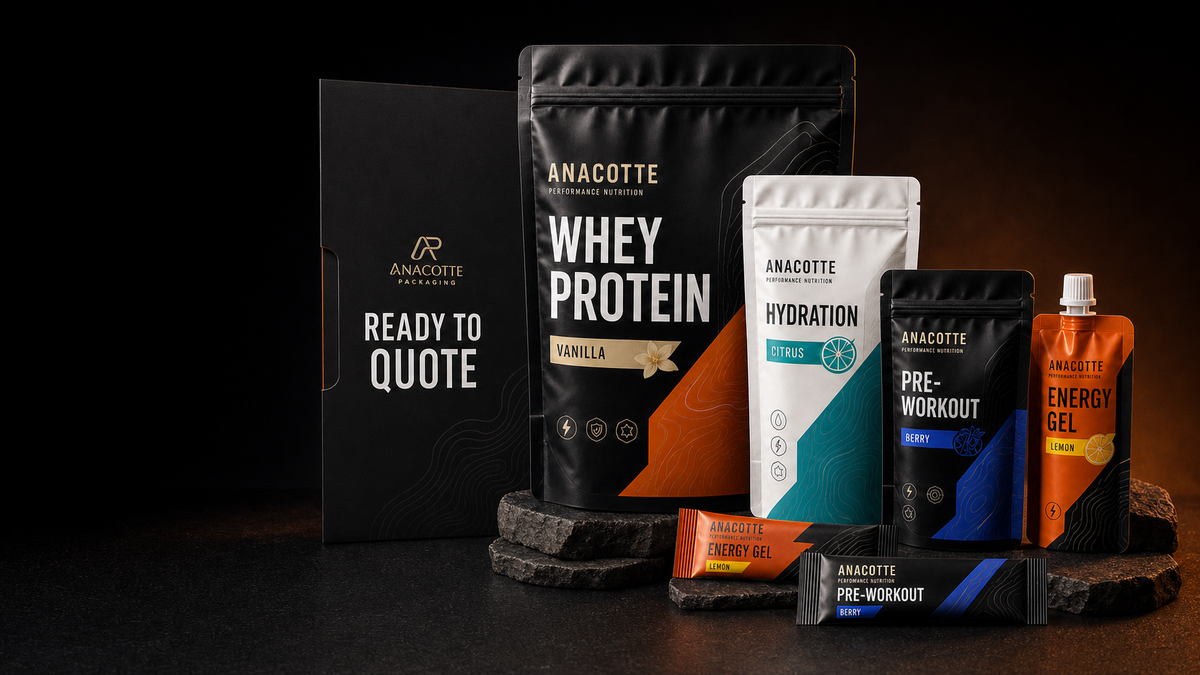
Nutrition brands rarely remain single-SKU for long. A protein line adds flavors. A hydration product adds caffeinated and non-caffeinated versions. A discovery pack introduces sachets beside a larger pouch. Each expansion creates commercial opportunity and packaging complexity.
The risk is not only higher inventory. Without a controlled system, every new SKU becomes a separate artwork project, proof cycle, barcode, formula panel and reorder decision. A multi-SKU strategy turns those variations into one managed packaging portfolio.
Quick Answer: Build multi-SKU nutrition packaging around one master architecture, one SKU map and one approval owner. Keep dimensions and materials shared where product fit allows, use digital printing for low-MOQ validation, give each SKU a measurable pilot objective, and set reorder rules before launch. Scale winners into larger quantities only when artwork, filling performance and demand are stable.
Define what counts as a SKU
A SKU is not only a flavor. Different fill sizes, formulas, serving counts, pack formats or channel versions may require separate inventory and identifiers. A berry 20-serving pouch and berry single-serve sachet are different operational products even if the visual system is related.
List every planned SKU before asking for a packaging quotation. The supplier needs both total quantity and quantity per artwork. A request for “5,000 pouches” is incomplete if it actually means five designs of 1,000 each.
Create a portfolio map
Start with a table that connects product, package and business purpose.
| SKU | Product role | Format | Fill | Pilot channel | Reorder signal |
|---|---|---|---|---|---|
| Core protein | Main revenue product | 1 kg flat-bottom pouch | 1 kg | DTC and gym retail | Repeat purchase |
| New flavor | Demand test | 500 g stand-up pouch | 500 g | DTC | Sell-through |
| Hydration sachet | Sampling | Single-serve sachet | One dose | Events and buyer kits | Trial-to-purchase |
| Energy gel | Format test | Small spout pouch | One serving | Endurance channel | Use feedback |
This map prevents the brand from using the same quantity logic for every product. A sampling SKU may be successful even if it does not reorder directly; its role may be to convert customers into a larger pouch.
Build one master design system
The master architecture defines shared elements: logo, hierarchy, typography, panel structure, information order, material finish and photography style. Variables should be explicit: flavor, color, ingredient panel, facts panel, barcode and fill quantity.
Use a template, not copy-and-paste. Duplicate files often retain the wrong flavor, net weight, barcode or metadata. The Obsidian SEO playbook identifies the same risk on duplicated Shopify products; packaging files have an even higher cost when errors reach print.
Review all SKU fronts and backs together. A system is only consistent when the family can be compared at once.
Decide what can be standardized
Shared specifications simplify production, but only when product requirements are compatible.
| Specification | Good candidate to standardize | When it may need to vary |
|---|---|---|
| Pouch width and height | Similar fill volumes | Density or serving count differs materially |
| Laminate | Similar sensitivity and process | High-fat, light-sensitive or processed SKU differs |
| Zipper and tear notch | Same consumer use | Single-use versus multi-use pack |
| Finish | Shared brand expression | Channel-specific premium treatment |
| Dieline | Same physical format | Different fill or equipment requirements |
Do not force a dense creatine and a fluffy protein into one pouch merely for artwork convenience. The protein powder size guide explains how to validate each fill.
Build the SKU control table
The SKU map should connect commercial names to technical files. Include:
- SKU code and customer-facing name;
- formula revision;
- package format and size;
- material structure;
- artwork filename and revision;
- facts panel and ingredient source;
- barcode;
- quantity;
- approval owner and date;
- production and reorder status.
Only one controlled row should represent each SKU. The proof owner should compare production files against that row, not against a previous email attachment.
Use low MOQ to buy evidence
Low-MOQ production is most useful when it reduces an important uncertainty. It can help a brand compare flavors, confirm buyer demand, test a new format or avoid excess packaging before regulatory copy is stable.
Anacotte supports suitable pre-made pouch programs starting from 200 units. Many early launches use 200–2,000 units per design. The correct quantity should cover production setup, launch inventory, samples and a meaningful observation period.
A tiny quantity that sells out to friends in one day may not provide useful channel evidence. A pilot needs a defined customer and test window.
Choose printing method at portfolio level
Digital printing can support several designs with lower tooling commitment. Gravure can become attractive when demand, artwork and SKU count are stable. Evaluate the entire portfolio rather than choosing process separately for each pack.
| Portfolio condition | Likely direction |
|---|---|
| Five flavors at 500 units each | Digital validation run |
| Two established SKUs at 30,000 each | Quote gravure and digital |
| One winner at 50,000 plus four tests at 500 | Hybrid: gravure winner, digital tests |
| Seasonal artwork with uncertain repeat | Digital may preserve flexibility |
Read the digital versus gravure guide for a complete comparison.
Approve artwork as a family
Every proof should show the exact SKU name, size, material and quantity. Create a family contact sheet with thumbnails and file names. Then perform two reviews:
- Horizontal review: compare the same field across every SKU, such as barcode, net weight or allergen statement.
- Vertical review: read one SKU from front to back as a consumer and production operator would.
The FDA's dietary supplement labeling guide explains federal labeling topics, and its food allergen resources include current guidance. Packaging artwork should receive appropriate regulatory and quality review.
Coordinate barcodes and case labels
Each retail SKU may require a unique identifier, and cases may need their own logistics labels. Verify requirements with GS1 and channel partners. GS1 US publishes barcode placement guidance.
Test the barcode on the filled package. A code positioned over a gusset, seam, curve or highly reflective area may scan differently than it appears on a flat proof. Do not resize or recolor without checking requirements.
Plan co-packer changeovers
Multiple flavors can increase cleaning, material staging and line-change time. Ask how the co-packer sequences SKUs, identifies packaging, controls formula changeover and reconciles unused pouches.
Packaging deliveries should be clearly labeled by SKU, artwork revision and count. If several designs look similar, use large outer-carton identifiers that do not rely only on subtle color differences.
Record the approved first-off filled unit for each SKU. A shared dieline does not guarantee identical filling behavior if powder density or flow differs.
Set pilot success metrics
Each SKU needs a threshold for scale, revise or stop.
| Metric | What it can reveal | Packaging action |
|---|---|---|
| Sell-through by week | Relative demand | Increase or reduce quantity |
| Repeat purchase | Product-market strength | Plan larger reorder |
| Buyer acceptance | Retail readiness | Prepare channel quantity |
| Damage or leakage | Package performance | Investigate before reorder |
| Fill yield and waste | Production fit | Correct size or settings |
| Customer confusion | Variant hierarchy | Revise design system |
Avoid changing formula, price, channel and packaging simultaneously if the goal is to learn which pack performs better.
Create a reorder calendar
Production and international freight require time. Set a reorder point that considers sales velocity, remaining finished goods, packaging lead time, co-packer schedule, shipping method and buffer.
Review quantities monthly during a pilot. If a flavor is winning, do not wait until zero inventory to request a larger print run. If a slow SKU has excessive packaging, consider bundles or sampling rather than automatically reprinting it.
Use a hybrid scale strategy
A mature portfolio does not need one printing method. High-volume core SKUs can move to gravure while new flavors remain digital. Single-serve samples may use rollstock, while larger pouches remain pre-made. The brand system connects them even when production paths differ.
The goal is not process purity. It is controlled economics and consistent customer experience.
Common multi-SKU mistakes
Common mistakes include quoting only total quantity, treating each flavor as an independent design, reusing barcodes, assuming equal weight means equal pouch size, approving files one at a time, and placing all SKUs into high-volume production before demand is known.
Another mistake is scaling unit cost before fixing the proof process. One incorrect high-volume SKU can cost more than the savings across the rest of the portfolio.
Frequently asked questions
How many SKUs should a startup launch?
Launch enough to test a meaningful choice without spreading inventory and attention too thin. Many early brands benefit from two to four controlled variants rather than a broad portfolio.
Can different SKUs share one order minimum?
Sometimes total quantity can be combined under a digital print program, but each design may still have a minimum. The quotation should state total pieces and pieces per artwork.
Should every flavor use the same material?
Only if formula sensitivity, fill volume and process are compatible. Confirm each product rather than standardizing by convenience.
What makes a SKU ready for gravure?
Stable artwork, predictable repeat demand, sufficient quantity and a clear calculation showing that tooling and inventory risk are justified.
Who should approve the proofs?
One named owner should coordinate brand, regulatory, quality and operations inputs. Multiple comments should be consolidated before returning revisions to the supplier.
Build your SKU map before requesting a quote
Submit product list, format, dimensions, material, total quantity, quantity per SKU, artwork status, co-packer and launch timing through the Anacotte project form. We can recommend a pilot, hybrid print plan or scale-up quotation. Production-ready portfolios can request pricing through Anacotte Packaging.


Leave a comment
This site is protected by hCaptcha and the hCaptcha Privacy Policy and Terms of Service apply.