
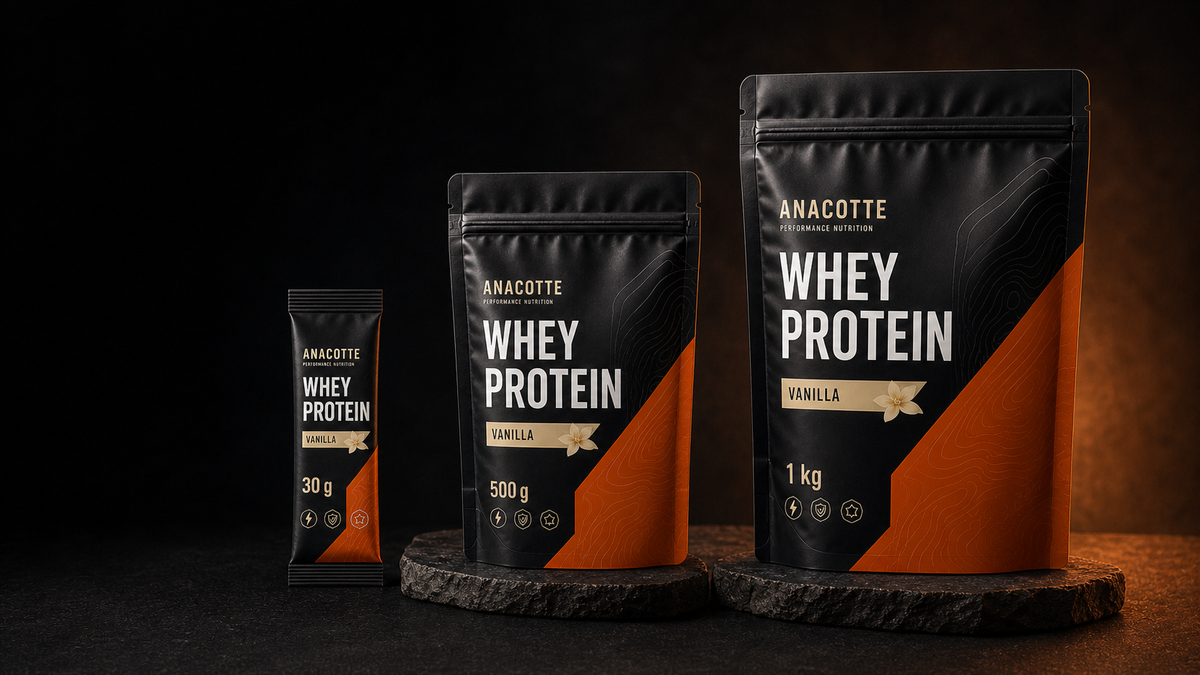
Protein powder brands often begin a packaging conversation with one question: “What pouch size fits 500 g or 1 kg?” It sounds simple, but net weight is not enough to determine dimensions. A light, aerated plant protein may occupy far more space than a dense creatine or electrolyte blend. Scoop size, desired headspace, zipper position and pouch geometry all change the answer.
A responsible size recommendation is therefore a starting point for testing, not a capacity guarantee. The brand or co-packer should confirm the final package with the actual product before production.
Quick Answer: To choose a protein powder pouch size, measure the product's occupied volume at the intended fill weight, add headspace for filling and consumer access, account for zipper and seal areas, and test the product in a physical pouch. Reference size ranges can narrow the search, but the final dimension should be approved only after a fill test with the real powder, scoop and packing process.
Why the same weight needs different pouch sizes
Bulk density describes how much mass occupies a given volume, including the spaces between particles. It changes with formulation, milling, humidity, aeration and handling. Two powders labeled 500 g can produce noticeably different fill heights in the same bag.
Powder also settles during transport. A pouch that looks well filled immediately after packing may develop more headspace later, while a bag sized too tightly can contaminate the zipper or top seal during filling. The objective is not to make every pouch look maximally full at the factory. It is to create a package that fills reliably, protects the product and remains convenient throughout use.
Understand the dimension order
Flexible pouch dimensions are usually expressed as width × height × gusset, but the way the gusset is stated can vary. A bottom gusset may be listed as the total unfolded depth or as two folded panels. Confirm the supplier's drawing instead of comparing numbers from different quotations at face value.
Usable volume is smaller than the geometric exterior. Side seals, the bottom seal, zipper, tear notch and top sealing allowance consume space. A flat-bottom pouch and a stand-up pouch with similar exterior dimensions can also have different internal geometry.
| Dimension | What it affects | Common mistake |
|---|---|---|
| Width | Opening access, scoop fit and front-panel area | Choosing a narrow bag that is hard to scoop from |
| Height | Fill level, zipper position and shelf presence | Counting the top seal area as usable volume |
| Gusset/depth | Capacity and ability to stand | Comparing folded and unfolded gusset values |
| Top seal allowance | Co-packer sealing area | Filling powder too close to the seal |
Always request a production dieline after the provisional size is selected. The dieline shows seal zones and helps the designer understand the true front-panel area.
Reference starting ranges by fill size
The ranges below are planning references for common powders, not guaranteed capacities. They are intentionally broad because formulations differ. Dimensions are width × height, with gusset or depth added where relevant.
| Intended fill | Common format | Starting test range | What to confirm |
|---|---|---|---|
| 15–40 g | Three-side-seal sachet | 70–110 × 120–180 mm | Dose volume, tear area, filler jaws |
| 100–250 g | Small stand-up pouch | 120–170 × 180–240 mm, 50–80 mm gusset | Scoop access and display proportion |
| 300–500 g | Stand-up or flat-bottom pouch | 160–220 × 230–300 mm, 70–110 mm depth | Product density, zipper clearance |
| 750 g–1 kg | Flat-bottom or large stand-up pouch | 220–280 × 320–400 mm, 90–130 mm depth | Filled stability, carton fit, carrying comfort |
Start near the middle of a range only when no reference package is available. If the brand already uses a tub or pouch, measure the occupied product volume and opening dimensions. A physical reference is more informative than a generic online capacity chart.
Measure occupied volume with the actual powder
Use a representative production batch, not a substitute such as flour or rice. Weigh the intended net contents, place the powder in a rigid graduated container without deliberately compressing it, and record the natural occupied volume. Repeat after gentle tapping to understand settling behavior.
This is not a substitute for laboratory density testing, but it gives the packaging team a practical starting point. Share the occupied volume, fill weight and photos with the supplier. If the formula is still changing, state the expected density range and keep the pouch size provisional.
The FDA explains that net quantity statements for dietary supplements must describe the amount of product in the package, excluding the packaging itself. Its net quantity guidance also discusses placement and expression. Confirm final artwork requirements with qualified regulatory support.
Add the right amount of headspace
Headspace serves three purposes: it keeps powder away from the seal, gives the zipper room to operate and makes consumer access easier. Too little headspace increases filling and sealing risk. Too much can make the package look underfilled or inefficient.
There is no universal percentage. The correct allowance depends on the filling method, powder flow, opening width, scoop and desired shelf appearance. Ask the co-packer how much vertical clearance its equipment requires. If filling is manual during a pilot, do not assume the same bag will run efficiently on a faster automatic line later.
Design around the scoop and user experience
A large scoop can become the hidden constraint. Measure scoop bowl width, handle length and the angle required to withdraw it. A pouch opening that technically accepts the scoop may still be frustrating after the fill level drops.
Consider how the consumer stores the scoop. If it sits inside the pouch, verify that the zipper closes without powder contamination. If it is attached externally or omitted, instructions and serving measurement may need a different solution.
For a single-serve product, the problem changes. The consumer should be able to tear the sachet cleanly, pour without trapping powder in corners and empty the full dose. Read the single-serve supplement sachet guide for format-specific decisions.
Choose stand-up or flat-bottom geometry
A stand-up pouch uses a bottom gusset and is often efficient for low-MOQ pilots. A flat-bottom pouch creates a box-like footprint and broad printable panels, which can suit larger fills or a premium shelf presentation. The best choice depends on filling, shipping, display and unit economics.
| Priority | Often favors stand-up pouch | Often favors flat-bottom pouch |
|---|---|---|
| Lower-complexity pilot | Yes | Sometimes |
| Broad front and side panels | Moderate | Strong |
| Large-fill stability | Depends on dimensions | Often strong |
| Compact empty shipping | Strong | Strong, but construction may be heavier |
| Premium box-like appearance | Moderate | Strong |
Do not select a flat-bottom bag solely because it appears larger in a rendering. Compare filled prototypes on the intended shelf and in the shipping carton.
Protect powder from moisture, oxygen and light
Size and material cannot be separated. Larger bags stay open through more consumer uses, making zipper quality and moisture control especially important. Some formulas also contain oxidation-sensitive fats, flavors or vitamins.
Ask the formulator for shelf-life targets and sensitivity information, then specify the needed performance. Transparent film, metallized film and aluminum-foil structures provide different barrier and visibility trade-offs. Our sports nutrition barrier film guide explains what to request from a supplier.
The inner layer should be suitable for the intended food-contact and sealing use. Review the FDA's food ingredient and packaging terms and obtain supplier declarations relevant to the finished laminate and market.
Confirm the co-packer's equipment limits
Before locking dimensions, ask the filler for minimum and maximum web or pouch width, opening method, dosing tolerance, seal width, sealing temperature range and expected line speed. A pre-made pouch may need a specific opening stiffness so automated grippers can handle it.
For manual pilot filling, document what changes before scale. A bag that works with a funnel may need a different opening or seal allowance on production equipment. The supplier, brand and co-packer should approve one drawing rather than carrying separate assumptions.
Run a structured physical fit test
Order two or three nearby stock sizes when possible. Fill each with the same weighed product and compare them using a written scorecard.
- Record fill height immediately and after settling.
- Seal and close the zipper repeatedly.
- Insert and remove the scoop at different fill levels.
- Check whether powder collects in the zipper channel.
- Stand the pouch on a shelf and place it in the shipping carton.
- Photograph front, side and top views with a ruler.
- Choose one size and record why it won.
If artwork and presentation remain uncertain, proceed to a custom printed sample. If filling performance is the main question, a small pilot may provide better evidence.
Plan artwork after size approval
The front panel must accommodate brand hierarchy, statement of identity and net quantity. The information panel may need Supplement Facts, ingredients, allergen information, directions, warnings, business details and coding space. The FDA's general dietary supplement labeling guidance lists core label statements for dietary supplements.
Create artwork on the supplier's dieline only after the provisional size is accepted. Then print the dieline at 100 percent and build a paper mockup. Small text that looks comfortable on screen may feel crowded on the physical package.
Common sizing mistakes
Avoid choosing a size from net weight alone, copying a competitor without measuring, ignoring the scoop, using exterior volume as usable volume, or leaving no clean sealing area. Another frequent error is changing formula density after the pouch has been approved.
Keep a controlled specification sheet with the exact dimension convention, tolerance, zipper position, seal areas and material. “Same as the previous sample” is not a production specification.
Frequently asked questions
What is the standard pouch size for 1 kg of protein powder?
There is no reliable universal size. A broad starting range may be roughly 220–280 mm wide by 320–400 mm high with a 90–130 mm depth or gusset, but the final size must be tested with the real powder and scoop.
How much empty space should be above the powder?
Enough to fill cleanly, protect the seal and allow zipper use. The amount depends on powder flow and filling equipment. Ask the co-packer for its minimum clearance and validate the shelf appearance with a filled sample.
Can I test capacity with another powder?
Only for rough visualization. Different powders have different bulk density and settling behavior. Final approval should use the intended product or a technically representative batch approved by the product team.
Is a flat-bottom pouch always better for 1 kg?
No. It often provides strong shelf stability and panel area, but a well-designed stand-up pouch can also work. Compare filling, cost, shipping and presentation before deciding.
Who should approve the final pouch size?
The brand should own the final approval with input from the packaging supplier and co-packer. When shelf life or process safety is involved, include the relevant technical and regulatory professionals.
Test before committing to production
Share your fill weight, occupied volume, powder type, scoop dimensions, preferred format, quantity per SKU and delivery country through the Anacotte project form. We can recommend nearby test sizes, arrange samples and help move the approved specification into a low-MOQ pilot. For a production quotation with print-ready artwork, use the Anacotte Packaging quote form.

Leave a comment
This site is protected by hCaptcha and the hCaptcha Privacy Policy and Terms of Service apply.