
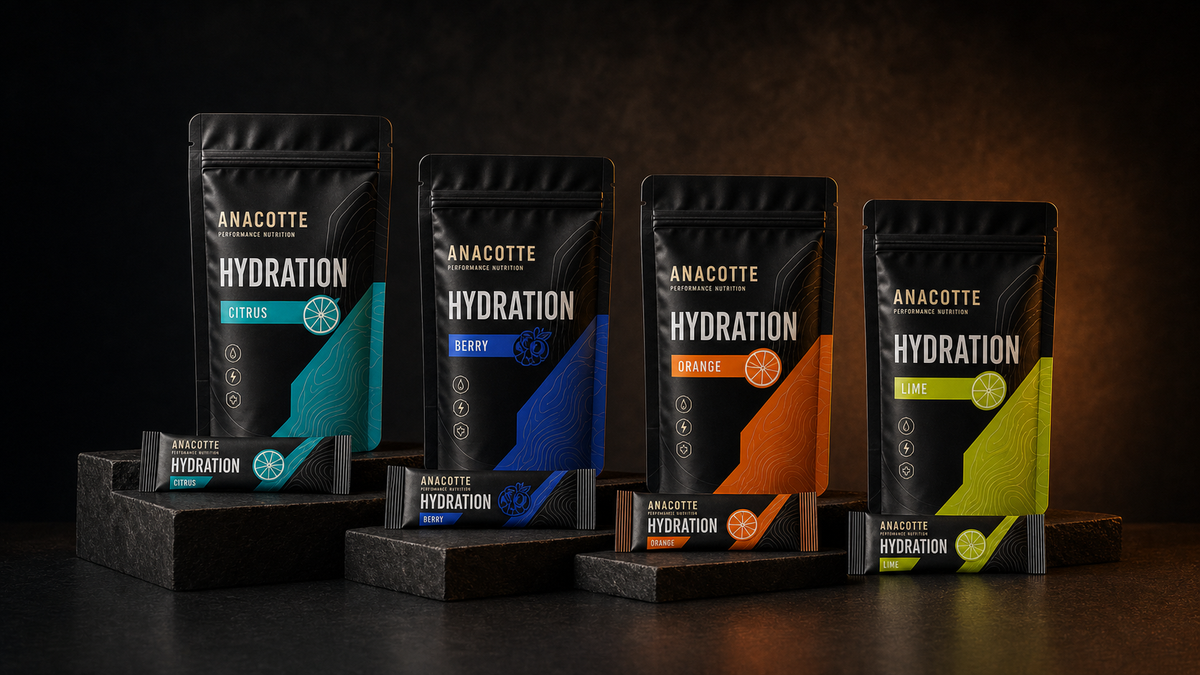
Electrolyte and hydration brands often launch with several flavors because the product experience depends on taste. That creates a packaging challenge: every flavor needs distinct artwork and accurate formula information, but the brand may not know which SKU will sell fastest. Large minimums can turn an exciting lineup into slow-moving packaging inventory.
The solution is not simply to order fewer units. A strong multi-SKU launch uses a shared packaging system, a controlled SKU map, a low-MOQ print path and a defined rule for reordering winners.
Quick Answer: For a multi-SKU electrolyte launch, keep dimensions and core material consistent across flavors, build one master artwork system, list every variable field in a SKU map, and use digital printing for a controlled pilot when quantities are low. Start with enough units per flavor to support filling, sampling and channel tests, then move winning SKUs into larger production only after artwork and demand are stable.
Why hydration brands are naturally multi-SKU
Flavor is often part of the value proposition. Citrus, berry, tropical and unflavored products may target different users or use occasions even when the base formula is similar. Brands also test caffeinated and non-caffeinated versions, serving counts and channel-specific packs.
Every variation multiplies operational work. Ingredients, allergen statements, Supplement Facts, barcodes, flavor colors and case labels can differ. Treating each file as an independent design increases the chance of inconsistency. The package family should be designed as a system.
Choose one primary launch format
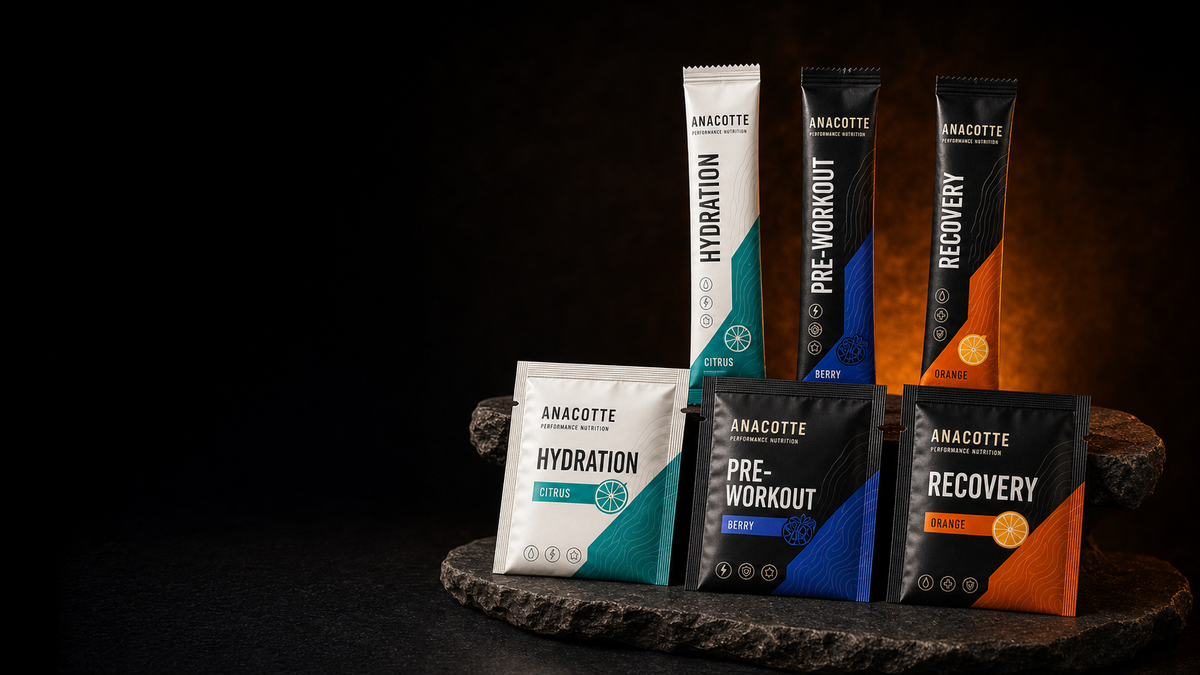
Hydration powder commonly appears in stand-up pouches, flat-bottom pouches, sachets or stick packs. A startup may eventually need several formats, but the first validation run should have a clear primary use.
| Launch goal | Useful starting format | Key question |
|---|---|---|
| Direct-to-consumer multi-serving product | Resealable stand-up pouch | Does the consumer need a scoop? |
| Travel and gym sampling | Sachet or stick pack | Can the co-packer run the dose and width? |
| Retail discovery bundle | Sachets inside a secondary pouch or carton | How are individual units labeled? |
| Premium larger fill | Flat-bottom pouch | Does the shelf presence justify added complexity? |
Avoid developing all formats at once unless the launch requires them. Each format adds a separate sizing, filling and artwork approval path.
Build a master packaging architecture
A master system locks the elements that should remain consistent: logo position, product hierarchy, information-panel structure, finish, dieline and pack dimensions. Variable zones accommodate flavor name, color, ingredients, facts panel and barcode.
The goal is controlled variety. Customers should recognize the family quickly while still distinguishing flavors. Use color as one cue, not the only cue. Flavor names and other identifiers should remain clear for accessibility and picking accuracy.
Print all SKUs side by side at actual size. Differences that are easy to spot on individual screens can become subtle on shelf or in a warehouse.
Create a SKU map before artwork approval
A SKU map is a simple table that prevents missing or mismatched information.
| Field | Citrus | Berry | Tropical | Unflavored |
|---|---|---|---|---|
| Formula revision | Record ID | Record ID | Record ID | Record ID |
| Flavor color | Approved code | Approved code | Approved code | Approved code |
| Supplement Facts | File/version | File/version | File/version | File/version |
| Ingredients/allergens | Approved copy | Approved copy | Approved copy | Approved copy |
| Barcode | Unique value | Unique value | Unique value | Unique value |
| Order quantity | Units | Units | Units | Units |
Add columns for artwork owner, regulatory approval, proof status and production quantity. One person should own the master tracker. Email threads are not an adequate SKU control system.
Set quantity per SKU from the test plan
The right pilot quantity is the smallest number that can produce meaningful operational and market evidence. It should cover filling setup, quality checks, photography, samples, launch inventory and a contingency allowance.
For an early brand, 200–2,000 units per SKU can be a practical validation range when the selected process supports it. The exact number depends on bag size, material, print method and co-packer economics. Avoid splitting a fixed total across too many flavors until every SKU has too few units to test properly.
A pilot is most useful when each SKU has a measurable question: conversion rate, repeat purchase, buyer interest, flavor preference or channel fit.
Use digital printing for controlled variation
Digital printing often suits low-MOQ multi-SKU work because it can reduce plate or cylinder dependency and make design changes easier. It is not automatically the cheapest method at every quantity. At larger stable volumes, gravure may produce a lower unit cost despite tooling and setup.
| Condition | Digital printing tends to fit | Gravure tends to fit |
|---|---|---|
| Quantity per SKU | Low to medium | Medium to high |
| Artwork changes | Frequent or not fully settled | Stable |
| Number of SKUs | Several | Few, at scale |
| Tooling commitment | Lower | Higher upfront |
| Unit-cost priority | Pilot economics | Volume economics |
Read the full digital versus gravure comparison before selecting a path.
Keep size and material consistent when possible
Sharing one pouch dimension and structure across flavors simplifies quoting, proofs, filling and reorders. It also lets the brand compare market response without changing several packaging variables.
Consistency is appropriate only when the formulas have similar fill volume and sensitivity. A high-fat or highly hygroscopic formula may require a different barrier. If bulk density differs, one flavor may look underfilled in a pouch sized for another. Confirm the real fill for every formula rather than assuming equal serving weight means equal volume.
Use the protein powder pouch size method and the high-barrier film framework to document exceptions.
Plan the information panel early
Electrolyte products may be marketed as conventional foods, dietary supplements or other product types depending on formulation and positioning. Classification affects required labeling. Do not use a competitor's panel as a template without qualified review.
The FDA's dietary supplement labeling guide explains federal supplement labeling topics. Its Nutrition Labeling chapter covers Supplement Facts considerations. The FTC's health products guidance is also relevant when packaging communicates performance or health-related claims.
Create a regulatory copy deck before visual polishing. Flavor changes often affect ingredients and allergens, so the information panel cannot always remain identical.
Validate color and finish with physical samples
On-screen color is not a production reference. Matte films, white ink, metallic substrates and spot effects alter appearance. A color that looks vivid on a monitor may become muted on a matte or metallized structure.
For a premium multi-SKU family, use custom printed prototypes or a tightly controlled pilot to compare the full lineup. Evaluate the packs under ecommerce photography lighting, retail lighting and ordinary room light.
Our custom printed sample guide explains which questions a prototype can answer and which require a production run.
Coordinate the co-packer and converter
The packaging supplier needs confirmed dimensions, structure, artwork and quantity. The co-packer needs pack opening, filling method, dosing tolerance, seal parameters and line schedule. The brand must connect those two conversations.
Before production, confirm:
- whether every SKU runs on the same settings;
- how flavor changeover is controlled;
- how printed rolls or pouches are identified;
- who supplies case labels and lot codes;
- what overage or shortage tolerance applies;
- which party approves the first filled units.
For sachets, lane order and eye marks can add another layer of SKU control. For pre-made pouches, count and label each design clearly.
Design the reorder before launch
A pilot should end with a decision, not an empty shelf and a rushed reorder. Define the evidence needed to scale a SKU. Useful signals include sell-through, repeat purchase, wholesale interest, customer feedback, damage rate and filling yield.
| Pilot outcome | Next packaging action |
|---|---|
| One clear winning flavor | Increase that SKU's quantity tier |
| Similar demand across flavors | Maintain balanced run and improve forecast |
| Artwork confusion | Revise variable hierarchy before reorder |
| Filling or sealing issue | Pause and correct specification |
| Slow SKU | Reduce, bundle or discontinue before large print run |
Keep reserve packaging only when the formula and artwork are stable. Obsolete printed film can erase the savings of a lower unit price.
Common multi-SKU mistakes
The most common mistake is launching too many flavors without enough demand evidence. Other errors include independent artwork files with no master control, duplicated barcodes, inconsistent facts panels, color-only identification, different bag sizes without a functional reason, and approving proofs one at a time rather than as a family.
Another mistake is comparing quotations only by total pieces. A 3,000-piece run spread across three designs is not operationally identical to one 3,000-piece design. Quotes should state total quantity and quantity per SKU.
Frequently asked questions
Can different flavors share one pouch size?
Yes, if occupied volume, filling and protection needs are compatible. Fill-test every formula because equal net weight does not guarantee equal volume.
What is a reasonable MOQ per flavor?
Anacotte's low-MOQ programs can start from 200 units for suitable pre-made pouch projects. Sachet rollstock and co-packing may require different minimums. The final answer depends on format and production route.
Should every flavor have a unique barcode?
Retail units that are distinct products generally need appropriate unique identifiers. Work with GS1 and your retail partners; GS1 US provides barcode placement guidance.
Can we change one SKU after proof approval?
Possibly, but changes can affect schedule, proof ownership and pricing. Use a formal version log and reapprove any altered file.
When should we move from digital to gravure?
When volume is predictable, artwork is stable and savings across the total run justify tooling and setup. There is no universal threshold; compare project-level quotations.
Build a controlled hydration pilot
Share your flavors, format, fill weight, occupied volume, number of designs, quantity per SKU, artwork status, co-packer and target launch date through the Anacotte project form. We can recommend the smallest useful sample or pilot path. Production-ready projects can request pricing from Anacotte Packaging.

Leave a comment
This site is protected by hCaptcha and the hCaptcha Privacy Policy and Terms of Service apply.