
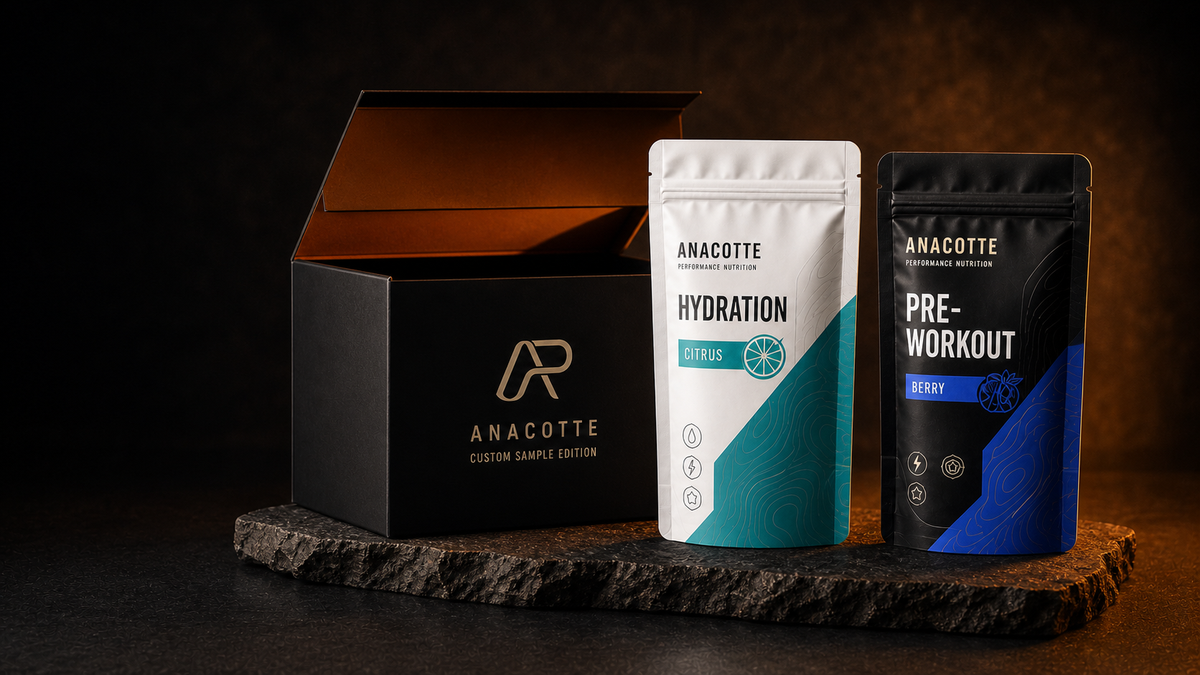
Packaging samples are valuable only when they answer a defined question. A stock pouch can confirm approximate size and zipper feel. A custom printed prototype can show artwork and finish. A pilot run can test filling and market response. Confusing these stages leads to either overspending or false confidence.
For early sports nutrition brands, the best sample is the smallest practical step that resolves the next major risk. A two-piece custom sample may be enough for engineering and presentation, while a 500-unit pilot may be necessary for filling, buyer outreach or a multi-flavor launch.
Quick Answer: Use a stock sample for basic size and material feel, a test-fit sample for real product capacity, a custom printed prototype for artwork and presentation, and a low-MOQ pilot for filling and market validation. Define what must be learned before ordering. Custom prototypes should not be treated as proof of full production yield or shelf life, and pilot runs should have measurable success criteria.
Why brands ask for samples
“I need a sample” can mean several different things. A founder may want to check whether the package feels premium, show it to an investor, confirm the product fits, test it with a co-packer, photograph it for a campaign or give units to a retail buyer.
State the sample goal in one sentence. For example:
- confirm that 1 kg of protein powder and the scoop fit;
- compare metallized and foil appearance;
- test a 26 mm spout with the filler;
- photograph two flavor concepts;
- provide 100 buyer samples;
- validate a zipper through repeated opening.
Once the goal is clear, the supplier can recommend the right stage.
Four sample stages
| Sample type | Typical quantity | Best for | Main limitation |
|---|---|---|---|
| Stock sample | A few pieces | General format, feel, zipper, approximate size | Not custom artwork or exact structure |
| Test-fit sample | A few filled pieces | Capacity, headspace, product access, equipment discussion | May use standard film and no custom print |
| Custom printed prototype | Often 1–10 pieces | Artwork, finish, presentation, engineering review | May use slower sample production, not volume process |
| Low-MOQ pilot | About 200–2,000 units per SKU | Filling, buyer samples, ecommerce, market response | Higher cost and commitment than prototypes |
The quantities are general. Actual minimums depend on format, material and process.
Stock samples: fast structural screening
Stock samples are existing bags similar to the intended package. They can often be delivered quickly and are useful for comparing stand-up versus flat-bottom construction, zipper feel, spout position or material opacity.
Use stock samples when the project still has basic questions. Fill them with the real product and record measurements. Do not assume a stock bag's film is the final recommended material, even if it looks similar.
For some Anacotte projects, a similar stock sample can be shipped for a modest courier fee that may be credited toward a later order. Current availability and delivery cost depend on destination and sample type.
Test-fit samples: answer the capacity question
A test-fit sample is chosen around size and product. It may be a blank stock bag or an unprinted custom-size sample. The objective is to confirm fill volume, headspace, scoop access, opening, secondary-pack fit or equipment compatibility.
Use the actual product whenever possible. Powders of equal weight occupy different volumes, and stacked sachets trap air at the seals. For gels, viscosity and residual product matter. Record the exact test fill, dimensions and results so the selected size can be traced later.
The protein powder size guide provides a structured fit-test method.
Custom printed prototypes: validate presentation and engineering
Custom prototypes reproduce the brand's artwork on a small number of physical packages. They are useful for evaluating print scale, finish, opacity, white ink, metallic appearance, fitment placement and overall presentation.
Anacotte can arrange two custom printed samples from approximately $150 including shipping for suitable standard structures; more specialized materials or components can cost more. Request current pricing because dimensions, laminate and fitment change the sample process.
A prototype should be marked as a development sample when appropriate. Handmade or short-run construction may not match the speed and variability of bulk production. It can support decisions without representing a production guarantee.
Pilot runs: validate the system
A low-MOQ pilot creates enough units to test more than one package. It can support filling trials, ecommerce photography, buyer meetings, subscription-box samples, event distribution and limited launch sales.
A pilot is particularly useful for multi-SKU sports nutrition brands. Quantities such as 200, 500, 1,000 or 2,000 units per design can provide market evidence without committing to a full gravure run, subject to the selected package and process.
Use the sports nutrition validation guide to define pilot goals and the multi-SKU strategy to plan reorders.
Choose a sample by the decision it supports
| Open decision | Best first sample | Evidence to collect |
|---|---|---|
| Which pouch format? | Stock samples | Standability, opening, panel space |
| What dimensions? | Test-fit samples | Fill height, headspace, carton fit |
| Which finish or artwork? | Custom printed prototypes | Physical color, texture, hierarchy |
| Does it run on equipment? | Line trial or pilot | Speed, seal quality, fill yield |
| Which flavor will sell? | Multi-SKU pilot | Sell-through, feedback, repeat order |
| Is shelf life acceptable? | Defined stability program | Product-specific data over time |
One sample cannot answer every row.
Prepare artwork before custom sampling
Custom samples require a production-ready or near-production-ready dieline. The designer should work on the supplier's exact template and account for seals, gussets, zipper, fitment, white ink, bleed and safe zones.
Before approving the file, check:
- correct dimensions and orientation;
- every SKU's name, flavor and quantity;
- facts panel and ingredient version;
- barcode and quiet zone;
- lot/date coding space;
- color and finish notes;
- spelling and claim approval;
- image resolution and embedded links.
The FDA's dietary supplement labeling guide covers federal labeling topics. The FTC's health products compliance guidance addresses substantiation of health-related claims. Obtain appropriate review before using a prototype in consumer-facing marketing.
Decide whether the sample needs exact material
If the goal is visual, a close sample laminate may be acceptable. If the goal is barrier, sealing or product compatibility, the exact structure matters. State which layers and performance requirements must match.
For a demanding oxygen target, a metallized visual substitute cannot prove the performance of a foil structure. For a clear window, a blank prototype cannot show opacity interaction with powder. Read the high-barrier film guide before defining the sample.
Use samples with co-packers and buyers differently
A co-packer needs engineering information: exact dimensions, opening, fitment drawing, seal area and material. A buyer may care more about shelf presence, branding, use and launch readiness. Label and distribute the samples accordingly.
For co-packer review, include a specification sheet and open questions. For buyer review, present a clean filled pack and clearly state whether artwork or material remains provisional. Do not ask the buyer to interpret an engineering sample without context.
Test in the real use environment
Open the package as the customer would. Place it in a gym bag, running belt, parcel mailer, retail display or kitchen cabinet. Test powder pouring into the intended shaker. Reclose multi-serving bags repeatedly. Check whether a spout cap can be handled with wet hands.
Use a written scorecard rather than general reactions such as “looks good.” Score capacity, opening, closure, stability, readability, perceived quality and any damage.
Understand what samples cannot prove
A custom prototype cannot establish shelf life, migration compliance, production yield, machine speed or long-run color consistency by itself. A stock sample cannot prove the exact final material. A pilot cannot predict every future market condition.
The FDA notes that food packaging materials and their intended uses are part of the food-contact framework. Review the FDA packaging overview and request supplier documentation. Use qualified professionals for product safety and regulatory conclusions.
Build a sample approval record
Photograph the approved sample and record:
- supplier and sample date;
- exact dimensions and convention;
- laminate and thickness;
- accessories and part numbers;
- artwork filename and revision;
- filled product and net quantity;
- approval comments;
- remaining risks before production.
Do not use “same as sample” as the only purchase specification. Physical samples should support a written specification, not replace it.
Common sampling mistakes
Common mistakes include ordering a printed sample before size testing, expecting a prototype to prove shelf life, sending outdated artwork, failing to specify the material, reviewing an empty pouch when shelf appearance depends on fill, and producing hundreds of units without a test goal.
Another mistake is requesting endless free revisions. A disciplined process uses early feedback, then moves into a paid prototype or pilot when physical evidence is needed.
Frequently asked questions
How long does a custom printed sample take?
Timing depends on artwork readiness, material and structure. Stock samples may arrive in about a week, while custom printed prototypes often need roughly two to three weeks including production and delivery. Confirm current timing for the project.
Is the custom sample fee credited to production?
Policies vary by sample type and order. Some stock-sample courier fees may be credited after a production order. Confirm the written quotation before payment.
Can two samples use different materials?
Yes, but each structure may require a separate sample setup and price. Compare only when the material decision is genuinely open and the test can distinguish the options.
Should I fill a custom printed prototype?
Yes when size, shelf appearance or use is part of the decision. Confirm that the sample is suitable for the intended engineering test and do not treat it as a commercial food package unless approved for that purpose.
When should I skip prototypes and go to a pilot?
When dimensions, artwork and material are sufficiently stable and the remaining questions concern filling, pack-to-pack consistency or market response, a pilot may provide more useful evidence.
Order the sample that answers the next question
Share your product, fill, pouch format, provisional size, material needs, artwork status, sample goal and destination through the Anacotte project form. We will recommend a stock sample, test-fit sample, custom printed prototype or low-MOQ pilot. Production-ready projects can request a quote from Anacotte Packaging.

Leave a comment
This site is protected by hCaptcha and the hCaptcha Privacy Policy and Terms of Service apply.