
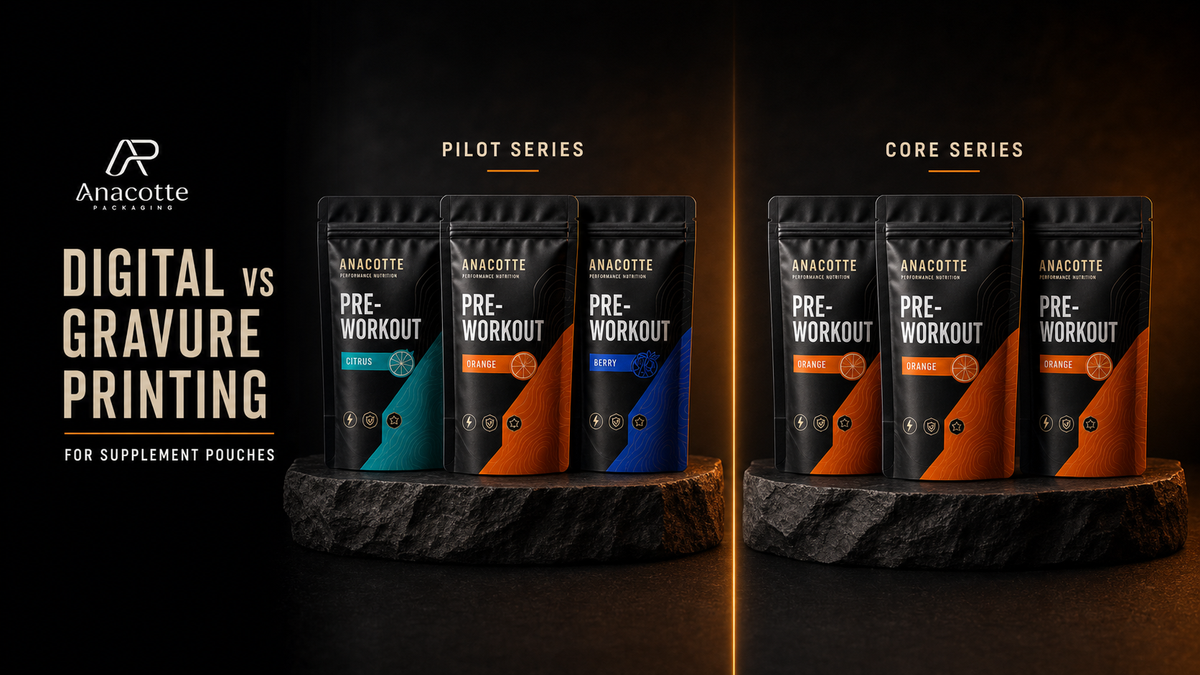
Printing method can change the economics of a sports nutrition launch more than a small material adjustment. Digital printing allows brands to test several designs at lower quantities without investing in a full set of gravure cylinders. Gravure can deliver strong unit economics when artwork and demand are stable. Neither method is universally better.
The right decision depends on total quantity, quantity per SKU, pouch size, number of colors, material, special finishes, artwork stability, lead time and reorder plan. Comparing only the lowest unit price hides the commercial risk of unsold printed inventory.
Quick Answer: Use digital printing when a sports nutrition brand needs a low-MOQ pilot, multiple flavors, fast artwork changes or market validation. Consider gravure when dimensions, structure and artwork are stable and the total quantity is large enough to offset cylinder and setup costs. As a planning rule, projects below roughly 10,000 units or with many small SKUs often suit digital, while stable runs above roughly 30,000 units can justify gravure—but the crossover must be calculated from current project quotations.
How digital pouch printing works commercially
Digital systems print artwork directly from production files without a dedicated cylinder for every color. This reduces tooling dependency and makes variable designs more practical. The process is especially useful when a brand is testing flavors, serving counts or buyer-specific versions.
Digital does not mean “no setup.” Files still require prepress, color management, white ink planning, proof approval, lamination and pouch conversion. Minimum order quantities also depend on film width, pouch geometry and the converter's production plan.
The commercial advantage is flexibility: the brand can buy information before buying scale.
How gravure printing works commercially
Gravure uses engraved cylinders to transfer ink to film. The setup cost is higher because each design and color separation may require tooling. Once a run reaches sufficient volume, the production cost per unit can become lower and high-speed repeatability can be attractive.
Gravure is most effective when the brand has stable artwork, predictable demand and few enough SKUs to use the cylinders repeatedly. A formula, claim or flavor change can make printed inventory or tooling less useful.
Compare the two methods
| Factor | Digital printing | Gravure printing |
|---|---|---|
| Typical strength | Low-MOQ and multi-SKU flexibility | High-volume unit economics |
| Printing tooling | Usually no gravure cylinders | Cylinders/setup required |
| Artwork changes | Easier before each run | Changes can require new tooling |
| SKU quantity | Practical at lower quantities | Stronger with stable larger quantities |
| Lead-time pattern | Often faster for pilots | Tooling adds preparation time |
| Color consistency | Strong with managed workflow | Strong on long controlled runs |
| Special effects | Process-dependent | Broad options, project-dependent |
| Best use | Validation, launches, seasonal designs | Repeat production and scale |
These are directional differences. Supplier capabilities vary, so confirm the exact process rather than assuming every digital or gravure line behaves identically.
Quantity thresholds are not fixed
Brands often ask for one number at which gravure becomes cheaper. There is no universal crossover because pouch area, material usage, cylinder count, finishes and SKU allocation all matter.
For Anacotte planning, quantities under about 10,000 total units frequently remain candidates for digital printing, especially when divided across several designs. When total volume rises above approximately 30,000 units and SKU count is limited, gravure becomes more attractive to quote. These are screening thresholds, not price promises.
Request both scenarios when the project sits near the crossover. Compare total landed project cost, not just factory unit cost.
Calculate quantity per SKU
A 10,000-unit project with one artwork is different from 10,000 units split across ten flavors. Each SKU needs its own file, proof, production control and inventory plan.
| Total units | SKU split | Commercial interpretation |
|---|---|---|
| 3,000 | 3 × 1,000 | Strong digital pilot candidate |
| 10,000 | 10 × 1,000 | Multi-SKU validation; digital often practical |
| 30,000 | 3 × 10,000 | Quote both methods |
| 90,000 | 3 × 30,000 | Gravure likely deserves serious evaluation |
| 90,000 | 18 × 5,000 | SKU complexity may preserve digital value |
The brand should forecast at SKU level. Total demand cannot compensate for a weak flavor if its printed packaging cannot be reassigned.
Include tooling and setup in the comparison
Gravure quotations may separate cylinder charges from unit cost. Ask whether cylinders are stored, how long they remain available, whether ownership transfers, and which changes require new engraving. Also confirm setup waste, proof costs and minimum run by design.
Digital quotations may include minimum converted-pouch charges, color-proof fees or special-finish premiums. A metallic surface, tactile coating, spot gloss or unusual white-ink treatment can change pricing under either method.
Use a full cost table:
| Cost element | Digital | Gravure |
|---|---|---|
| Prepress/artwork preparation | Include | Include |
| Printing tooling | Usually lower | Cylinder cost |
| Base pouch production | Quantity-based | Quantity-based |
| SKU setup | Confirm | Confirm by design/cylinder |
| Sample/proof | Confirm | Confirm |
| Freight | Quote separately by method | Quote separately by method |
Freight should not be hidden when air and ocean delivery differ substantially. A lower factory price can lose its advantage if the chosen run must move by expensive air freight.
Consider artwork stability
Packaging for sports nutrition can change after formula, serving size, claims or regulatory review. If the facts panel or ingredients are not final, avoid committing to large printed inventory merely to reach a lower unit price.
The FDA's dietary supplement labeling guide covers federal labeling topics. The FTC's health products compliance guidance explains that health-related advertising claims should be truthful, not misleading and supported. Packaging artwork should complete appropriate review before scale.
Digital production can function as a bridge: the brand validates the package and cleans the file, then transfers a stable design into gravure.
Compare color and finish realistically
Digital and gravure may render gradients, fine lines, solids and metallic effects differently. The substrate, white ink and overprint finish also influence color. A soft-touch film can mute saturation; a metallized base can create reflective highlights.
Approve color against a physical standard where color is critical. A monitor or office printer is not a production reference. Ask whether the supplier targets Pantone colors, CMYK values, a contract proof or a signed production sample.
When transferring from digital to gravure, expect a color-matching exercise. The goal is acceptable brand consistency, not pixel-identical output from different processes.
Factor in lead time and change control
Digital projects often move quickly once the dieline and artwork are approved. Gravure needs cylinder preparation before printing. Actual schedules depend on workload, material availability, converting and shipping.
Create a timeline with separate gates:
- dimension and structure approval;
- production-ready dieline;
- artwork and regulatory approval;
- physical proof or sample if required;
- printing and lamination;
- pouch conversion;
- inspection and shipment.
Do not quote a final delivery date from artwork approval alone if materials or filling components remain open.
Use digital for learning, not permanent indecision
Digital printing is powerful when a pilot has defined questions. It is less useful when a brand repeatedly orders small quantities without analyzing demand or stabilizing artwork.
A strong pilot records sell-through by SKU, filling yield, customer feedback, damage and reorder timing. Once a SKU has predictable demand, calculate whether gravure lowers total cost without creating excess inventory.
Read the multi-SKU packaging strategy for a structured scale-up plan.
Decide whether freight is included
For very small sample or pilot orders, a delivered price can simplify the decision. For larger production, separate packaging and freight. Spout pouches are heavier than simple flat pouches, and air versus ocean shipping can change the landed cost significantly.
Provide destination postal code, delivery terms and preferred speed. Ask for packaging weight and carton dimensions where possible. A quotation should state whether duties, taxes or customs charges are included.
Common printing-method mistakes
Common mistakes include comparing unit prices at different specifications, ignoring quantity per SKU, assuming digital has no setup, assuming gravure color is automatically superior, ordering high volume before regulatory review, and failing to include freight.
Another mistake is forcing a project into gravure solely because total units are high while each SKU remains small. SKU complexity belongs in the economic model.
Frequently asked questions
Is digital printing good enough for retail packaging?
Yes, digital printing can produce high-quality retail pouches. Suitability depends on the supplier, material, color requirements and finish—not on the word “digital” alone.
Does gravure always have a lower unit price?
No. It generally becomes attractive at larger stable volumes, but cylinders, setup and SKU changes must be included. At low quantities, digital can have a better total project cost.
Can multiple SKUs share gravure cylinders?
Shared elements may be possible in some workflows, but variable artwork often requires distinct tooling or planning. Ask the printer for the exact separation and cylinder strategy.
Can we start digital and move to gravure later?
Yes. This is often a sensible path. Keep source artwork organized and plan for color matching and prepress adjustments when transferring processes.
Should shipping be included in the unit price?
For samples or very small orders, a delivered total can be useful. For larger runs, separate product and freight so the brand can compare air, ocean and timing clearly.
Compare both paths with one specification
Submit pouch format, exact dimensions, material, quantity per SKU, number of artworks, finishes, accessories, artwork status and destination through the Anacotte project form. We can help compare a validation run with a scale-up scenario. Production-ready requests can go directly to Anacotte Packaging.


Leave a comment
This site is protected by hCaptcha and the hCaptcha Privacy Policy and Terms of Service apply.