
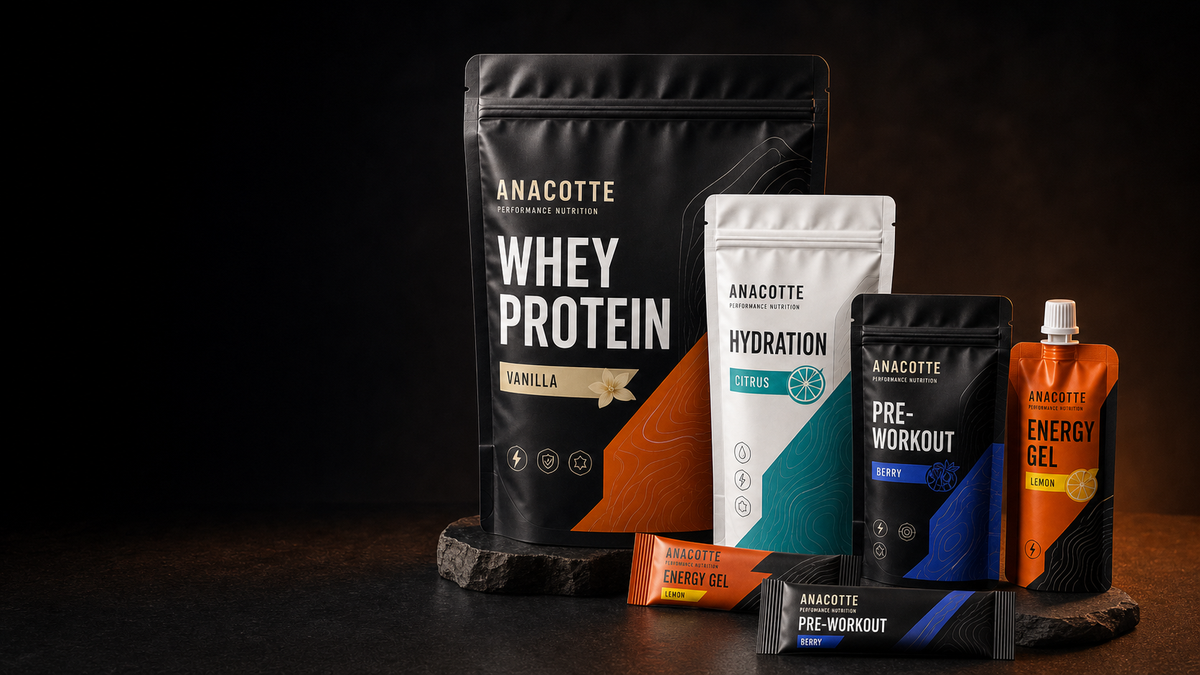
Launching a sports nutrition product creates a deceptively difficult packaging problem. A founder may know the formula, serving size and visual direction, yet still be unsure whether the pouch stands properly, whether the scoop fits, whether a sachet tears cleanly, or whether an energy gel can be filled through the intended spout. Ordering thousands of units before answering those questions turns packaging into a costly bet.
Anacotte's recommended approach is to validate packaging in stages. The goal is not to eliminate every possible risk with one prototype. It is to answer the highest-impact questions with the smallest useful test, document what is learned, and scale only after the package has earned that next commitment.
Quick Answer: Sports nutrition packaging validation is the process of testing size, structure, material, artwork, filling, handling and market response before a full production run. Start with a clear brief, use a stock or custom sample for fit and presentation checks, run a small pilot when functional performance matters, and record every approved specification. A low-MOQ pilot of 200–2,000 units can be far less risky than placing a large order based only on a digital mockup.
What packaging validation actually means
Validation is broader than approving a PDF proof. A proof can confirm copy placement and artwork direction, but it cannot prove that 30 sachets fit in a secondary pouch, that a 1 kg powder bag has enough headspace, or that a spout works with a co-packer's filling nozzle.
A practical validation program separates questions into five groups:
| Validation area | Question to answer | Evidence to collect |
|---|---|---|
| Product fit | Does the intended fill fit with usable headspace? | Filled sample, weight and dimensions |
| Package function | Do zipper, tear notch, seal and spout work in use? | Opening, closing, leak and handling tests |
| Barrier | Is the structure appropriate for shelf-life goals? | Supplier specifications and relevant test data |
| Artwork | Are required panels, barcodes and SKU details correct? | Approved dieline and physical print sample |
| Operations | Can the co-packer fill and seal it consistently? | Line trial, seal settings and written approval |
The package is ready to scale only when the evidence matches the product's real use conditions. A package that looks excellent on a studio table but fails on the filling line is not validated.
Start with a supplier-ready product brief
A good brief reduces expensive back-and-forth. It should include the product type, fill weight or volume, product state, storage conditions, target shelf life, preferred pouch format, number of SKUs, quantity per SKU, artwork status, launch date and delivery destination.
For powders, add bulk density, scoop dimensions and whether the consumer needs room to stir or insert a scoop. For liquids and gels, add viscosity, fill temperature, treatment process, cap preference and the co-packer's filling equipment. If any answer is unknown, label it as an open test item rather than guessing.
Use the Anacotte project form to organize these details before asking for a final quote. If the product direction is still changing, the brief should state which decisions are fixed and which are provisional.
Validate size with the actual product
Pouch capacity charts are only starting references. Powders with the same net weight can occupy very different volumes because particle size, aeration and bulk density vary. A dense creatine powder does not behave like a fluffy plant protein. Thirty individual wipes or sachets create a different stack profile from one loose fill.
The safer process is straightforward:
- Measure a current reference package or build a paper volume mockup.
- Fill a stock pouch with the real product at the intended net weight.
- Allow space for settling, the zipper, top seal and consumer access.
- Test the pouch standing, lying flat and packed into its shipping carton.
- Freeze, heat or condition samples only when those conditions match the real product journey.
Our protein powder pouch size guide explains this process in more detail. Any recommended dimension should remain provisional until a physical fill test is complete.
Match material to the product, not the category label
“Supplement pouch” is not a material specification. A pouch may use an outer print web, a barrier layer and an inner sealant layer, but the right combination depends on moisture sensitivity, oxygen sensitivity, light exposure, sealing process, distribution and shelf-life targets.
The most important principle is to start from a performance requirement. If a formula is highly moisture-sensitive, ask for a target water-vapor transmission rate and supplier test data. If oxidation or light exposure is the main concern, evaluate higher-barrier options and the trade-off between transparency and protection. Read the high-barrier film guide before choosing between transparent, metallized and foil structures.
Food-contact suitability must also be reviewed for the intended use. The FDA explains that packaging components can be food-contact substances and that intended use matters when assessing them. Review the FDA food-contact packaging overview and request appropriate supplier documentation for the finished structure.
Use the smallest useful sample stage
Not every project needs the same sample. Choose the least expensive stage that can answer the next decision.
| Sample stage | Best for | What it cannot prove |
|---|---|---|
| Stock sample | Size, feel, zipper and general structure | Final print color or exact custom construction |
| Test-fit sample | Capacity, headspace, secondary-pack fit | Production consistency across a run |
| Custom printed prototype | Artwork, finish, presentation and engineering review | Full-line yield or unit economics |
| Low-MOQ pilot | Filling, packing, buyer samples and market response | Economics of a mature high-volume run |
Anacotte can support custom printed packaging samples and low-MOQ pilot production. The correct stage depends on whether the immediate risk is visual, dimensional, functional or commercial.
Test the filling and sealing process
The converter makes the package, but the co-packer proves whether it works in production. Confirm the available opening width, filling nozzle size, sealing jaw width, temperature range, pressure, dwell time and line speed. For spout pouches, confirm fitment dimensions and the sequence in which the spout, cap and any membrane are installed.
Ask the co-packer to document trial observations. A seal that looks closed can still contain powder contamination or a channel leak. A pouch can be technically fillable but too slow for the target line. Packaging decisions should reflect both package performance and operating reality.
For powders, run filled-package drop and compression checks that resemble parcel delivery. For gels or liquids, include cap torque, inversion and leakage checks. Test methods should be selected by the responsible technical team; a startup should not treat a casual desk test as a formal certification.
Validate artwork and regulatory space
Sports nutrition packaging often needs more information than founders expect. Depending on how a product is classified and sold, the artwork may need a statement of identity, net quantity, Supplement Facts or Nutrition Facts, ingredient information, allergen declarations, business details, directions, warnings, lot coding space and a barcode.
The FDA's dietary supplement labeling guide describes federal labeling considerations, while the FTC's health products compliance guidance explains why health-related claims should be truthful, not misleading and appropriately substantiated. These sources do not replace review by qualified regulatory counsel.
Reserve compliant space before design becomes visually locked. Check minimum type, contrast, quiet zones, seam interference and zipper placement on the production dieline. A beautiful concept that cannot accommodate required copy is not production-ready.
Build a four-stage validation path
Most early brands can use a staged path instead of jumping directly to a large order.
| Stage | Typical output | Decision gate |
|---|---|---|
| 1. Brief | Product, SKU, format and risk map | Are the key inputs known? |
| 2. Prototype | Stock or custom sample | Does it fit, function and present correctly? |
| 3. Pilot | 200–2,000 units per SKU | Can it fill, ship and sell? |
| 4. Scale | Optimized print and quantity tier | Are specifications stable enough for volume? |
The pilot should have written learning goals. For example: confirm 20-serving fill, compare two finishes with buyers, check tear behavior after six weeks, or determine which of three flavors reorders fastest. Without a learning goal, a small order is merely a smaller purchase, not a validation run.
Common validation mistakes
The first mistake is approving dimensions from fill weight alone. The second is choosing a film because another brand uses it without confirming product sensitivity. The third is treating a rendered mockup as proof of production appearance. The fourth is changing artwork, dimensions and materials at the same time, which makes test results hard to interpret.
Another common mistake is asking a supplier to guarantee shelf life without product data or a defined test protocol. Packaging contributes to protection, but formula stability, water activity, oxygen exposure, filling hygiene, storage and distribution also matter. Assign ownership of shelf-life decisions to the appropriate product and regulatory professionals.
How long should validation take?
A stock-sample fit check may take about a week including delivery. A custom printed prototype commonly takes longer because a production-ready dieline and artwork approval are required. A pilot run adds production and shipping time. The right schedule includes time for customer feedback and one controlled revision, not just factory days.
Plan backwards from the launch date and identify the last responsible date for locking size, material, artwork and quantity. If the launch depends on retailer review, build the buyer sample date into the schedule rather than treating it as an informal milestone.
Frequently asked questions
What should a startup validate first?
Validate the issue that could invalidate every later decision. Usually that is product fit and filling compatibility, followed by material and artwork. There is little value in perfecting graphics on a format the co-packer cannot fill.
Is a digital proof enough before ordering?
No. A digital proof is useful for layout approval, but it cannot demonstrate pouch feel, opacity, metallic effect, zipper function, capacity or filling behavior. Use a physical sample when those factors matter.
How many units should a pilot include?
Use enough units to run the intended filling process, supply relevant buyers or testers, and observe real handling. Anacotte's low-MOQ programs can start from 200 units, but the correct pilot quantity depends on SKU count and test goals.
Can one sample prove shelf life?
No. Shelf-life validation requires a defined protocol and product-specific evidence. A sample can support early screening, but it should not be presented as a shelf-life guarantee.
When should a brand move to high-volume printing?
Move when the dimensions, materials, artwork and SKU mix are stable and forecast confidence justifies tooling or setup. Compare digital and gravure printing based on total project economics, not unit price alone.
Start with the smallest useful test
If you are building a protein powder, hydration mix, single-serve supplement or energy gel, start a packaging project. Anacotte will review the product, fill, format, SKU count and launch plan, then recommend a stock sample, custom printed prototype, low-MOQ pilot or scale-up path. For production-focused flexible packaging inquiries, you can also request a packaging quote.


Leave a comment
This site is protected by hCaptcha and the hCaptcha Privacy Policy and Terms of Service apply.