
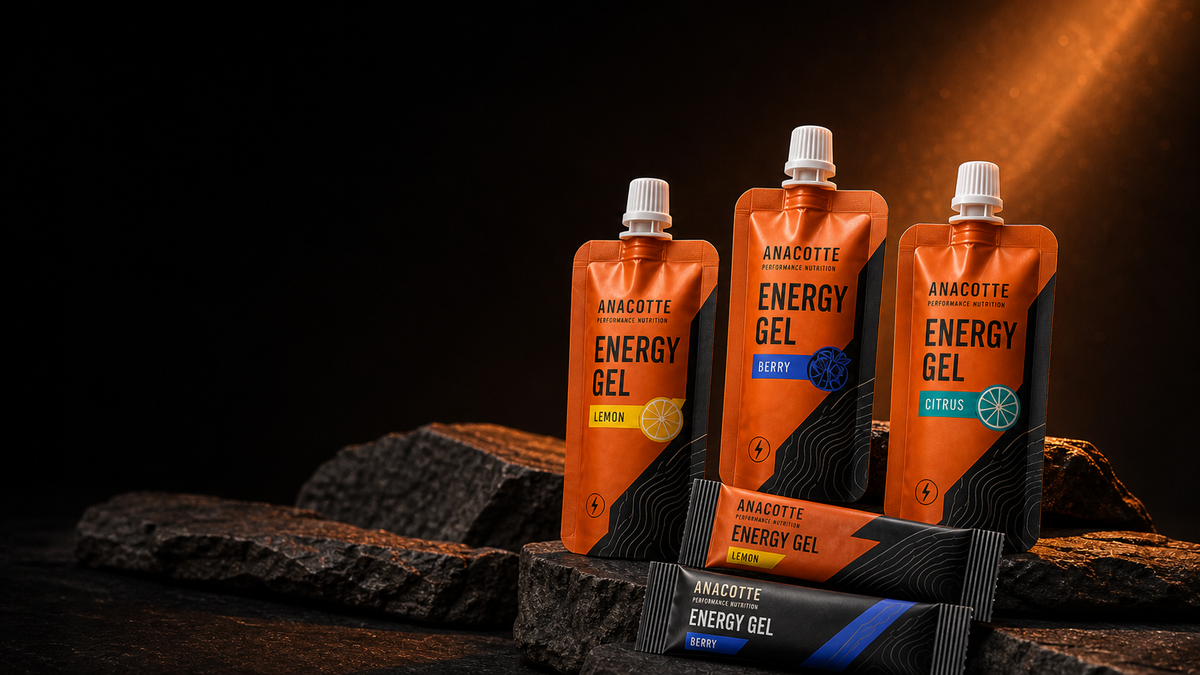
Energy gel packaging sits at the intersection of product rheology, flexible film, molded fitments and real-world athletic use. The package must be small enough to carry, strong enough to survive compression, easy to open with one hand and compatible with the filling process. A visually appealing pouch is only the beginning.
Startups often focus first on pouch capacity or cap color. The higher-risk questions are whether the gel flows through the selected fitment, whether the co-packer can fill and seal the pouch, and whether the finished pack leaks or becomes difficult to use under realistic conditions.
Quick Answer: Develop an energy gel spout pouch by defining dose volume, viscosity range, fill temperature, treatment process and use conditions before selecting the spout. Confirm fitment dimensions with the co-packer, choose a laminate based on product and process requirements, test cap torque and seal integrity, and produce custom samples or a low-MOQ pilot before volume production. Never approve a spout or material from a rendering alone.
Define the product before choosing the package
“Energy gel” can describe products with very different flow behavior. Some are thin enough to pour quickly; others contain fibers, suspended particles or thick carbohydrate systems. Viscosity can also change with temperature.
Prepare a technical brief with:
- target fill weight and volume;
- minimum and maximum expected viscosity;
- particle size or inclusions;
- fill temperature;
- pH and other compatibility information identified by the formulator;
- preservation or treatment process;
- target shelf life and storage conditions;
- intended consumption method.
The packaging supplier should not be expected to infer these details from a flavor name or marketing description.
Choose between tear-top and spout formats
Traditional gel packs often use a tear-open flexible packet. A spout pouch can support resealing, controlled consumption or a larger serving, but adds fitment cost, weight and filling complexity.
| Format | Strengths | Watch-outs |
|---|---|---|
| Tear-top packet | Compact, low component count, familiar use | Torn tab, opening control, one-time use |
| Small spout pouch | Resealable, controlled dispensing, strong product differentiation | Fitment, cap torque, filling and leak testing |
| Larger multi-serve spout pouch | More servings per pack, possible refill use | Consumer dosing, repeated opening, higher barrier demand |
Use the simplest format that solves the customer problem. A spout should earn its complexity by improving use, dose control or product positioning.
Select the fitment from flow and equipment
The nominal spout size is not the complete specification. The co-packer and pouch converter need a detailed fitment drawing showing the bore, flange, threads, cap and any tamper-evident features. Two “15 mm” spouts may not be interchangeable.
Confirm:
- whether the gel flows through the internal bore at production temperature;
- whether the filling nozzle fits the spout or the pouch is filled before fitment installation;
- whether the flange can be sealed into the selected laminate;
- whether cap threads and torque are controlled;
- whether an induction or heat-sealed membrane is required;
- whether the cap needs a tether, tamper band or other feature for the target market.
Ask the co-packer to approve the fitment drawing. Do not assume the pouch supplier's standard fitment automatically matches the filling line.
Understand the production sequence
Spout pouches can be produced and filled in several sequences. Some arrive with the spout already welded and are filled through it. Others are filled through an open edge, then sealed. A project may also involve a membrane and cap installed before or after filling.
Map the entire sequence:
| Step | Decision to confirm | Failure risk |
|---|---|---|
| Pouch conversion | Spout position and flange seal | Weak weld or distortion |
| Component assembly | Membrane and cap order | Incompatible sealing sequence |
| Filling | Through spout or open edge | Slow flow, product contamination |
| Final seal | Width, temperature, pressure and dwell | Channel leak or burn-through |
| Packing | Cap orientation and compression | Loosening or abrasion |
When a co-packer bottom-fills and bottom-seals a pre-spouted pouch, confirm opening width, seal area and equipment settings. A stable prototype process should be documented before bulk packaging is made.
Size the pouch around use, not just volume
A gel pouch needs some headspace, but too much can create an awkward pack. The user's grip area, cap clearance and pocket fit matter. Test filled pouches in running belts, cycling jerseys, hydration vests and shipping cartons as relevant to the product.
Use the actual gel for the size test. Water is not a reliable substitute for viscosity or residual product behavior. Check how much gel remains in corners and around the spout after consumption. Package geometry can affect product evacuation.
If the pack is intended for one hand, evaluate cap diameter, opening force and reclosure with wet or sweaty hands. Avoid treating a desk demonstration as a complete usability test.
Select a laminate for product and process
The structure may need to resist moisture, oxygen, light, flavor interaction, flexing and seal stress around the fitment. The inner layer also participates in heat sealing and product contact. There is no universal “energy gel film.”
| Requirement | Packaging question |
|---|---|
| Oxygen or light sensitivity | What OTR, opacity or foil-level barrier is required? |
| Repeated flexing | Does the structure tolerate pocket and shipping flex? |
| Fill temperature | Is the sealant and fitment compatible with the process? |
| Treatment process | Has the complete pouch been evaluated for the intended process? |
| Product contact | Are the materials suitable for the formula and market? |
The FDA describes a food-contact substance as a material component intended to contact food without having a technical effect in the food. Review the FDA food-contact packaging overview and request relevant supplier declarations. Product compatibility and shelf life remain project-specific.
Treat the spout weld as a critical area
The transition between flexible laminate and rigid fitment concentrates stress. Inspect the flange area for wrinkles, channels, incomplete seals and distortion. Filled samples should be tested in orientations that load the spout differently.
Useful development checks can include inversion, cap torque, squeeze, drop, compression and transport simulation, selected by the responsible technical team. If the product is hot-filled, processed or stored under unusual conditions, the test plan must reproduce those conditions rather than rely on a room-temperature leak check.
Document the accepted fitment supplier and part number. Substituting a visually similar fitment can change welding and filling performance.
Plan tamper evidence and consumer opening
Tamper evidence can come from a cap band, membrane, secondary seal or other design. Each option changes assembly and consumer experience. Confirm whether the target retailer or market has specific expectations.
If using a membrane, determine how it is sealed, how the consumer removes it and whether the gel can contact the seal area. A molded-fiber overcap or protective component may introduce additional fit, moisture and transportation questions. Prototype the complete component stack, not only the pouch.
Build compliant artwork around a small pack
Small spout pouches have limited uninterrupted panel area. Fitment zones, seals and curves reduce the space available for product identity, net quantity, ingredients, nutrition or supplement information, directions, warnings and coding.
The FDA's general dietary supplement labeling guide lists core federal statements for dietary supplements. The FTC's health products compliance guidance explains the importance of substantiating express and implied health-related claims. Classification and artwork should be reviewed by qualified professionals for the specific product.
Place variable lot and date coding where the co-packer's equipment can reach it. Check barcode placement on the filled, curved package rather than on a flat screen.
Use prototypes for engineering, not only appearance
A custom printed prototype can support fit, artwork, finish, product evacuation and handling tests. If the exact production film and fitment are available, it becomes more useful for engineering discussion. It still may not prove line speed or production yield.
A sensible development sequence is:
- standard fitment and stock pouch screening;
- two custom printed engineering samples;
- filled handling and leakage checks;
- co-packer line trial or low-MOQ pilot;
- documented revisions before scale.
Using an in-stock standard fitment during early testing can be more economical than opening a custom mold. Custom molded components often require tooling and much larger minimum quantities, so they should follow proof of the core package concept.
Plan quantity and printing method
Low-MOQ digital printing can be appropriate when a startup is testing several flavors or cap colors. At higher volume with stable artwork, gravure may reduce unit cost. Spout pouch economics also include fitment, welding and heavier freight compared with a simple flat sachet.
Use the digital versus gravure guide to compare print paths and the multi-SKU strategy guide to plan quantities by flavor.
Common energy gel packaging mistakes
Common errors include selecting a spout by outside diameter only, ignoring viscosity change with temperature, assuming a food-grade statement proves formula compatibility, approving a package without the co-packer, leaving insufficient bottom-seal area, and opening custom tooling before a standard component has been tested.
Another error is optimizing the unit price before confirming filling yield. A low-cost pouch that slows the line or leaks in transit is not economical.
Frequently asked questions
What spout size is best for energy gel?
There is no universal size. The bore must suit viscosity and particles, while the flange and threads must match pouch conversion and filling equipment. Test an in-stock option with the real product first.
Can the pouch be filled from the bottom?
Often yes, depending on construction and equipment. Confirm the open width, final seal width, temperature, pressure, dwell time and contamination control with the co-packer.
Do I need a custom cap mold?
Not for initial validation. A standard fitment and cap usually provide a lower-risk engineering test. Consider custom tooling after function and demand are proven.
Can a custom prototype prove the pouch is shelf-stable?
No. It can support early compatibility and handling observations, but shelf-life approval requires product-specific testing and a defined process.
Are spout pouches more expensive to ship?
They are generally heavier than simple flat pouches because of molded components. Quote freight separately when quantities are large or delivery methods differ significantly.
Start an energy gel packaging test
Provide fill volume, viscosity range, process, target fitment, number of SKUs, quantity, co-packer details, artwork status and shipping destination through the Anacotte project form. We can help identify a standard-fitment sample, custom prototype or pilot path before custom tooling or volume production. Production-ready projects can use the Anacotte Packaging quote form.


Leave a comment
This site is protected by hCaptcha and the hCaptcha Privacy Policy and Terms of Service apply.