
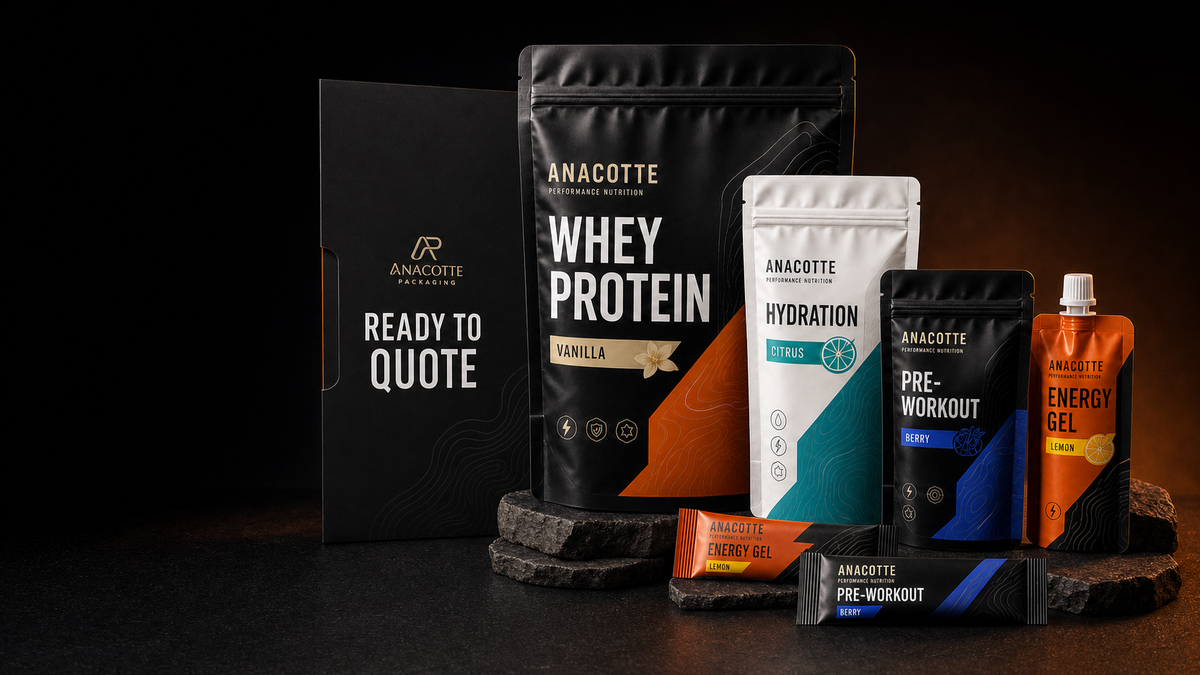
A packaging quote is only as useful as the specification behind it. “Please quote 1,000 protein bags” leaves the supplier guessing about dimensions, material, zipper, number of designs, artwork, delivery and even the product itself. Two suppliers can return very different prices because they priced different assumptions.
A strong quote brief does not need to solve every technical question. It should separate confirmed requirements from open decisions and provide enough context for the supplier to recommend the next validation step.
Quick Answer: A sports nutrition packaging quote should include product type and state, fill weight or volume, occupied volume or reference size, pouch format, dimensions, material or barrier target, accessories, total quantity, quantity per SKU, artwork status, filling process, target date and complete delivery destination. Label uncertain items clearly. Ask the supplier to state exclusions, sample options, production time, freight method and the assumptions behind the price.
1. Describe the product
Start with what goes inside the package. “Supplement” is too broad because powders, gummies and gels need different structures and filling processes.
Provide:
- product name or internal project name;
- product state: powder, granule, gummy, gel, liquid or solid;
- formula category: protein, electrolyte, pre-workout, recovery or other;
- whether the product is sold as a dietary supplement, conventional food or another classification under review;
- relevant sensitivity: moisture, oxygen, light, aroma or puncture;
- storage: ambient, refrigerated, frozen or other;
- target shelf life.
If formulation remains confidential, share the performance-relevant facts under an NDA when appropriate.
2. State fill weight, volume and occupied volume
Net weight alone may not determine pouch size. Include the intended fill weight and, for powders, the natural occupied volume or bulk density if known. For gels and liquids, provide fill volume and viscosity range.
| Product | Essential sizing input | Useful supporting detail |
|---|---|---|
| Protein powder | Fill weight and occupied volume | Scoop size and density |
| Electrolyte sachet | Dose weight and volume | Powder flow and bottle opening |
| Gummies | Count, dimensions and weight | Oil or sugar coating |
| Energy gel | Fill volume and viscosity | Spout bore and use method |
Attach photos of the product in a measuring container or current package when available.
3. Choose or describe the pouch format
Common options include stand-up pouch, flat-bottom pouch, three-side-seal sachet, center-seal bag, side-gusset bag and spout pouch. If the format is open, explain the use case rather than forcing a guess.
For example: “We need a resealable 500 g powder pack that stands on shelf and allows scoop access” is more useful than “quote any bag.” The supplier can then compare suitable structures.
Review sports nutrition packaging by market and the single-serve sachet guide for common directions.
4. Provide dimensions correctly
State width × height × gusset or depth in millimeters and inches where helpful. Clarify whether the gusset is total depth or one folded side. Attach a current bag, drawing or link to a reference package.
If size is not confirmed, provide product volume and request sample sizes for testing. Do not ask the supplier to guarantee capacity from weight alone. Use the protein powder pouch size guide to prepare a test brief.
5. Define material by performance
If an exact laminate has been approved, list every layer and thickness. If not, provide the barrier goal, product sensitivity, shelf life and process.
Useful phrasing:
- “Recommend a high-moisture-barrier opaque structure for a hygroscopic powder.”
- “Target OTR is 0.01 cc/m²/day under stated test conditions; please recommend and provide data.”
- “We want a clear window, but light sensitivity is still under review.”
- “The co-packer requires a sealant compatible with its process settings.”
The high-barrier film guide explains how to compare transparent, metallized and foil directions.
6. List every accessory and feature
Accessories change price, weight and lead time. Specify:
- zipper type;
- tear notch;
- one-way degassing valve;
- spout, fitment and cap;
- handle or hang hole;
- rounded corners;
- transparent window;
- laser score;
- surface finish;
- spot gloss, metallic effect or tactile film;
- child-resistant closure when required.
For spouts, attach a fitment drawing and part number rather than using only a nominal diameter. State whether the component is standard or custom.
7. Separate total quantity and quantity per SKU
This is one of the most important quote fields. List every artwork and its unit count.
| SKU | Format/size | Quantity | Artwork status |
|---|---|---|---|
| Citrus hydration | 500 g stand-up pouch | 500 | Final review |
| Berry hydration | Same | 500 | Final review |
| Unflavored hydration | Same | 500 | Draft |
| Sample sachet | Single serve | 2,000 | Not started |
The total is 3,500 units across four designs, not one 3,500-unit artwork. Printing method and price depend on this distinction.
8. Explain artwork status
Choose one clear status:
- no artwork yet;
- design concept only;
- artwork in progress;
- artwork ready for dieline adaptation;
- production-ready artwork on the supplier's dieline;
- previously printed file requiring review.
Include the expected completion date. A quote can be estimated before artwork is final, but special effects, ink coverage and design count may change the price.
Before production, confirm bleed, safe zones, white ink, barcode, variable coding area, color references and linked images. A rendered mockup is not a print-ready file.
9. Provide filling and co-packer information
State whether filling is manual, semi-automatic or automatic. Include co-packer equipment and contact information when possible. For pre-made pouches, confirm opening and seal requirements. For sachets, provide rollstock or form-fill-seal specifications. For spout pouches, describe the filling sequence.
Ask the co-packer for:
- minimum and maximum dimensions;
- filling nozzle or auger requirements;
- seal width and settings;
- line speed;
- zipper or fitment limitations;
- coding location;
- test quantity.
Packaging and filling should not be quoted as disconnected systems.
10. State validation and sample needs
Tell the supplier which evidence is needed before production. Options can include a stock sample, test-fit sample, custom printed prototype, line trial or low-MOQ pilot.
Use the custom printed packaging sample guide to choose. If the project requires market validation, specify how many buyer, influencer or test units are needed.
11. Give target dates in sequence
“Need ASAP” does not create a schedule. Provide:
- artwork-ready date;
- sample-needed date;
- approval date;
- production completion target;
- delivery target;
- launch or buyer-meeting date.
Ask the quotation to separate sample time, production time and transit time. Artwork changes reset parts of the schedule, so include review time.
12. Provide a complete delivery destination
Freight requires country, city, postal code and preferably a full commercial address. State whether delivery is to a residence, warehouse, Amazon facility, co-packer or freight forwarder.
For small samples, an all-in courier price is simple. For larger runs, request separate air and ocean options when appropriate. Confirm whether the quote includes duties, taxes, customs clearance and final-mile delivery.
Spout pouches and large flat-bottom pouches may weigh more than simple sachets. Packaging weight and carton dimensions improve freight estimates.
13. Ask for quote assumptions and exclusions
A useful quotation should state what it includes. Request:
- material and nominal thickness;
- pouch format and dimensions;
- printing method;
- quantity by SKU;
- accessories and finish;
- tooling or setup fees;
- sample cost;
- production lead time;
- freight method and cost;
- payment terms;
- quote validity;
- overage/shortage tolerance;
- exclusions.
If the supplier recommends a substitute structure or size, ask it to label the change clearly.
14. Include regulatory and food-contact questions
Packaging suppliers can provide material declarations and production information, but they should not be asked to approve the formula or marketing claims. State the target market and request relevant documentation for the intended use.
The FDA's food-contact packaging overview explains the food-contact framework. The FDA's dietary supplement labeling guide and the FTC's health products guidance are useful starting points for labeling and claims. Use qualified regulatory support for product-specific approval.
Copyable quote checklist
Use this short brief when contacting a supplier:
- Product and state:
- Fill weight/volume and occupied volume:
- Storage and shelf-life target:
- Pouch format:
- Dimensions or reference package:
- Material or barrier target:
- Zipper/spout/valve/window/finish:
- Number of SKUs:
- Quantity per SKU:
- Artwork status and ready date:
- Filling method and co-packer limits:
- Sample or pilot objective:
- Delivery country, city and postal code:
- Required delivery date:
- Open technical questions:
Common quote-request mistakes
Common mistakes include giving only net weight, hiding the number of SKUs, using a competitor photo as the complete specification, omitting destination, asking for a final price before material and size are known, and assuming freight is included.
Another mistake is requesting one “best price” without quantity tiers. Ask for relevant pilot and scale scenarios so the business can understand the trade-off.
Frequently asked questions
Can I get a quote without final artwork?
Yes, a budget estimate is often possible. State the number of designs and expected effects. Final pricing should be confirmed after artwork and specifications are reviewed.
What if I do not know the pouch size?
Provide fill weight, occupied volume, product state, scoop or component dimensions and a reference package. Ask for nearby stock samples, then approve size through a physical test.
Should shipping be included in the quote?
Request packaging and freight as separate lines for larger orders, with air and ocean options where useful. For small samples, an all-in courier fee may be clearer.
How many quantity tiers should I request?
Request tiers tied to decisions, such as 200 or 500 for pilot, 1,000 or 2,000 for launch, and a larger scale scenario. Avoid asking for many arbitrary tiers that do not match a buying plan.
Who owns the final specification?
The brand should approve the final specification with input from supplier, co-packer and relevant technical or regulatory professionals. Keep a written record of the approved dimensions, material, artwork and accessories.
Send a complete brief and get a useful next step
Use the Anacotte project form to submit the checklist. If important details are still open, we will recommend samples or a validation path. If dimensions, material and artwork are production-ready, request a formal quotation through Anacotte Packaging.


Leave a comment
This site is protected by hCaptcha and the hCaptcha Privacy Policy and Terms of Service apply.